
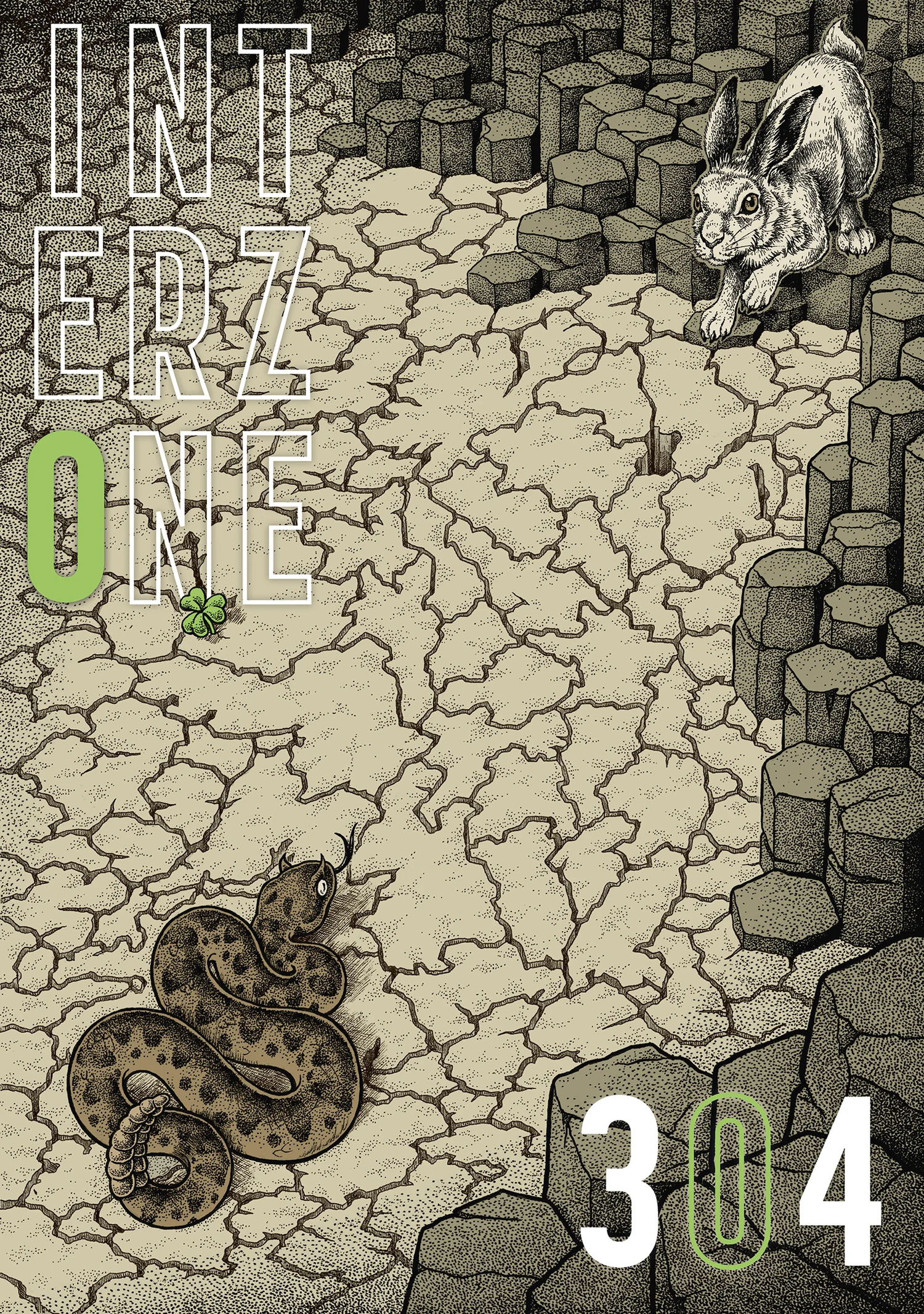
I’m late, we’re late. Oh gosh, it’s been months since this issue of Interzone came out, but luckily the next one isn’t quite out the door, so I’ve still got time to tell you how much I enjoyed one of the best spec-fit (or fantastika, as IZ puts it) magazines out there.
Without further ado, let’s get on to the stories!
County Colours
Val Nolan’s “County Colours” is the reason this review is so late. I read it, and then I had to put the issue down and read something else, because nothing was going to top this story for joyful and ridiculous creativity.
The setup is that something messes with geography. Different geographic regions of Ireland are just shuffled around the world within a moment: suddenly County Mayo, Ireland is in Japan, Limerick is in Detroit, Wexford is in the Pacific. Stop right there, think about the brilliance of that concept, imagine the implications in your world-building of that displacement, the storytelling impact for this world and over lay that notion on diaspora on what you know of the Irish diaspora.
Told out of sequence, with each chapter indicating the number of days since the “Scattering”. Una, our protagonist, becomes an investigator looking into the causes. It feels a little bit X-Files in this part, but I love the X-Files. There’s globe-trotting, there’s scientific mystery and skulduggery. I won’t spoil it any more. If you don’t love this story it’s possible that we can’t be friends.
BODYSWAP.GOV
R.T. Ester’s “Bodyswap.gov” is also lots of fun, but it’s a more zany kind of fun. What if you could Freaky-Friday swap bodies with someone? And what if a useful tech idiot ran the company and had connections with the Pentagon and the adult industry, and did a swap as demonstration. It’s quite silly, but enjoyable.
Reboot the Sky
At times during this one, I felt that Dominic Green was channelling just a touch of Gene Wolfe’s Long Sun sequence, as both are set on a generation starship, and both concern hidden mysteries and the nature of violence, but “Reboot the Sky” moves quickly where Wolfe is thoughtful, languorous. Thupaq and his classmates are taken from an agricultural area inside the generation ship (once an asteroid) to learn and take over the piloting after an attack wipes out most of the “Sky people” responsible for getting the ship to its destination. The mechanics of how and why of the attackers is nicely convincing, and Thupaq’s transition from bored student to cold and calculating commander of the ship is both exciting and chilling — I cheered for him, and was then left wondering how ruthless he was going to be.
The Island Without Spice
Jennifer Jeanne McArdle’s “The Island Without Spice” has a lot going on. Set in the 17th century around the “spice islands” (now part of Indonesia), Girtrud escapes a massacre (the Banda massacre, 1621) perpetrated by the Dutch East Indian Company and makes a new life on a different island, which has nothing the colonialists want. Except that she is inevitably confronted by more Europeans: a Dutch alchemist looking for one of those mysterious and elusive magical items, quite literally an “allspice” (because even when you don’t have what they want, they’ll make something up anyway). This alchemist and his crew of cursed men cause trouble for the defenceless islanders.
This is a great read, and McArdle tackles colonialism, the displacement of populations (and thus immigration) as well as belief and violence. I noted that the island is named Pulau Lingkaran, which means circular island, and the story is circular too: it begins with a massacre, and ends with a new group of people taking possession of a ship and weapons, reminding us that violence begats violence.
NKATA
‘NKATA’ by Simon Guerrier is one of those stories which takes a rather mundane and everyday occurrence and then twists it ever so slightly, just exaggerates one tiny little aspect of it, and then shows the consequences. In this case, it’s those “final bill warning” letters that arrive addressed to someone who might once have lived in your house. NKATA stands for “not known at this address,” and maybe we should just mind our business and not get involved? Except, well, we always do, don’t we? Can’t say more, spoilers.
Cops and Robbers #1: The Bridge
Rachael Cupp’s story sequence Year in Blue has been appearing in Interzone for ten issues now, and many of the stories count among my personal favourites. Each one tells a different and personal story set in the aftermath of some kind of nuclear conflict. ‘Cops and Robbers #1’ takes the form of a script for a comic book, written by a child or young man, trying to map out the narrative of the moment the alarms went off, and then he and some others ran for the shelter, and then the bombs drop. It is full of quiet moments attempting to express the inexpressible horror of these moments.
“Sm. cap: Kaboom Kaboom Kaboom. A noise so loud it is only white. And this from the bombs striking far away.”
Or this:
“I mean, this is the first time in my life where I ever saw someone hit a guy and it seemed like the hit deserved a sound effect like that.
But also,
Sm cap: Collapse of a city thundering down.”
I had my doubts when I saw it formatted as a script, but they evaporated immediately. I’ll be buying the complete Year in Blue whenever it comes out
There we go, another excellent issue of Interzone. I haven’t even mentioned the reviews and articles – there’s Una McCormack on Ursula Le Guin, Alexander Glass on Zelazny, Val Nolan on medieval Irish “sky ships, tons of reviews. A bargain, a bargain I tell you! You’ve just got time to pick this one up and read it before the next one comes along, so hurry up, get reading!

Leave a Reply